
The conventional wisdom in the aggregate industry has long held that a two-stage crushing circuit—a jaw crusher machine for primary reduction followed by a cone crusher for secondary—is the standard for hard, abrasive materials like granite. This configuration is predicated on the assumption that the output from a well-operated secondary cone will meet the stringent gradation requirements for most construction aggregates. However, as market demands evolve towards finer specifications, higher cubicity, and the necessity to process more contaminated feed, the limitations of this binary approach become starkly apparent. Two-stage crushing, while efficient, often fails to deliver the precise particle size distribution required for premium asphalt and concrete products. This necessitates the inclusion of a tertiary or quaternary stage, transforming the circuit into a multi-stage process that unlocks the true value of the deposit.
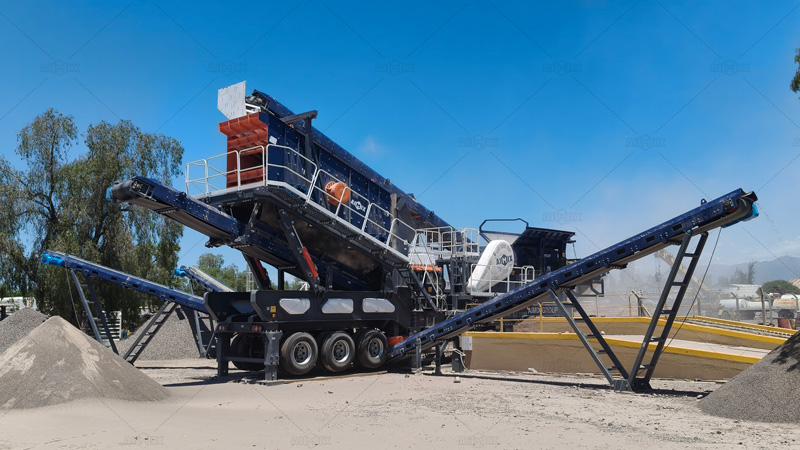
1. The Rationale Behind the Third Stage
The decision to incorporate a tertiary stage is not a failure of the initial design; it is a strategic response to the physical realities of granite comminution and the exigencies of modern specifications.
Addressing the “Cubicity Deficit”
A jaw and cone configuration excels at reducing the size of the rock, but it does not inherently produce a product that is optimally cubical. The compression crushing mechanism tends to generate a higher percentage of “flaky” or elongated particles, which are detrimental to the workability and strength of concrete. A tertiary stage, typically a high-speed cone crusher or a vertical shaft impactor (VSI), is employed to “re-crush” this material. The high-speed action of these machines fractures the rock along its internal planes, breaking down the flaky edges and producing a more symmetrical, cubical aggregate. This refinement is critical for meeting the strict spec for high-performance concrete, where interlock is paramount.
Managing the Fines and Oversize “Splitting”
As the closed-side setting on the secondary cone is tightened to produce a finer product, the granite crusher machine begins to generate an excessive amount of dust, known as “-3mm” material. This dust can be challenging to manage and often saturates the market, offering low returns. Conversely, if the setting is too open, the circuit produces too much “+25mm” oversize that is rejected. A tertiary crusher provides the operational flexibility to “split” these fractions. It can be operated to specifically target the production of premium sand (0-4mm) or to reduce the oversize to the desired spec, thus optimizing the yield of high-value products.
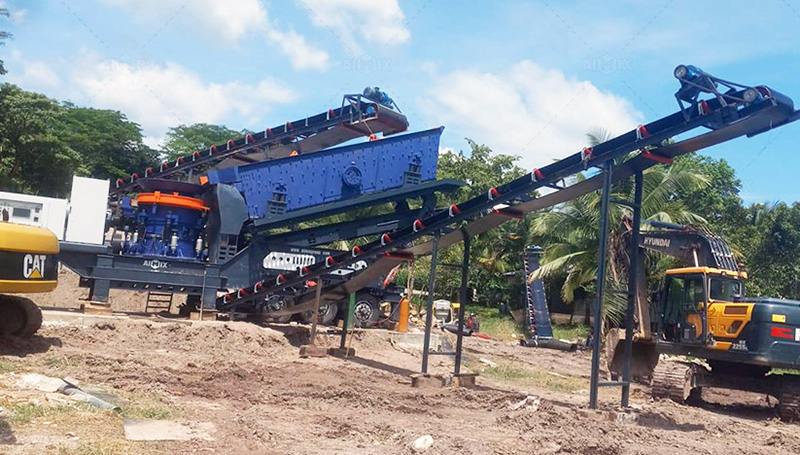
2. The Configuration of a Multi-Stage Circuit
When two stages are insufficient, the engineer must design a tailored process flow sheet. This typically involves a primary, secondary, tertiary, and occasionally a quaternary stage.
The Role of Screening in Multi-Stage Flowsheets
In a multi-stage circuit, the screen becomes the traffic controller. After the secondary crusher, the material passes over a large, multi-deck screen. The top deck removes the oversize material and feeds it back to the tertiary crusher, creating a closed circuit. The middle deck captures the mid-sized aggregate, which is either sold directly or sent to a VSI for shaping. The bottom deck manages the fines and dust. This intricate screening network ensures that each crusher is processing only the material it is designed for, maximising efficiency and minimising over-grinding. This closed-loop system is the engine of product quality.
Crusher Types for Tertiary and Quaternary Applications
The selection of the tertiary crusher is a decision of grave consequence. A short-head cone crusher is a common choice for tertiary applications. It operates with a steep crushing chamber and a small discharge setting, providing fine reduction. For the ultimate in cubicity, a Vertical Shaft Impactor (VSI) is often deployed in the quaternary stage. The VSI sand making machine utilises a high-speed rotor to throw the rock against a stationary anvil, breaking it through impact rather than compression. This produces a product with an exceptional shape and a high percentage of crushed faces, which is highly prized for asphalt surface courses.
The move to a multi-stage circuit is an investment in infrastructure and operating costs, yet it is often the only path to profitability in a demanding market.
Total Cost of Ownership and Wear Economics
Operating a tertiary or quaternary circuit increases the initial capital outlay and the ongoing cost of wear parts. A VSI, for example, has high wear costs on its rotor tips and anvils. However, the economic calculus must consider the “value added.” A stone crusher machine that produces a premium aggregate that commands a 30% higher price per ton justifies the additional wear cost. The contractor is not just crushing rock; they are manufacturing a high-value construction material. The key is to analyse the Total Cost of Ownership (TCO) in relation to the revenue stream, ensuring that the additional stages are profitable.
Reducing the “Fines” Burden
One of the most insidious costs in a granite operation is the disposal of excess fines. In a two-stage circuit, producing a fine material often requires a significant reduction ratio in the secondary cone, which generates copious amounts of -6mm dust. A multi-stage circuit distributes the required reduction across three machines. This allows each machine to operate at a higher efficiency, and the total generation of unmarketable dust can be effectively controlled. This reduction in waste disposal costs directly improves the operation’s net profit margin.